You can select a beautiful tile and still end up with a disappointing room. Tile is the element where the specification around the product — substrate, setting-out, slip rating, joint width and grout colour — does as much work as the tile itself. It is also the element with the least forgiveness: once it is set, it is set.
Here is what we work through before a single box is ordered.
Porcelain, ceramic and the difference that matters
Porcelain is fired denser and hotter than ceramic, absorbs almost no water and is suitable for floors, wet areas and outdoors. Ceramic is lighter and easier to cut but generally belongs on walls. Full-body porcelain carries its colour through the whole tile rather than in a surface glaze, so a chip is far less visible — worth specifying in an entry or a commercial-grade floor.
Rectification is the other word worth knowing. A rectified tile has been mechanically ground to an exact size after firing, which is what allows a tight, consistent 2 to 3mm grout joint. Non-rectified and handmade tiles vary in size by design and need wider joints to absorb it.
Slip rating is a safety specification, not a style
In Australia, slip resistance is tested to AS 4586 and expressed as a P-rating. For a domestic bathroom floor we specify P3 as a minimum, P4 for shower bases and covered external transitions, and P5 for pool surrounds, external steps and ramps. Internal dry floors are commonly P2.
You will often see a European R-rating quoted instead. The two are not interchangeable; as a rough guide R10 corresponds to about P3–P4. Where safety matters, ask for the tested Australian P-rating for the exact finish you are ordering, and put it in your specification.
The same tile in a polished and a structured finish can be two entirely different slip ratings. Never judge grip by the material name.
Large format: fewer joints, higher standards
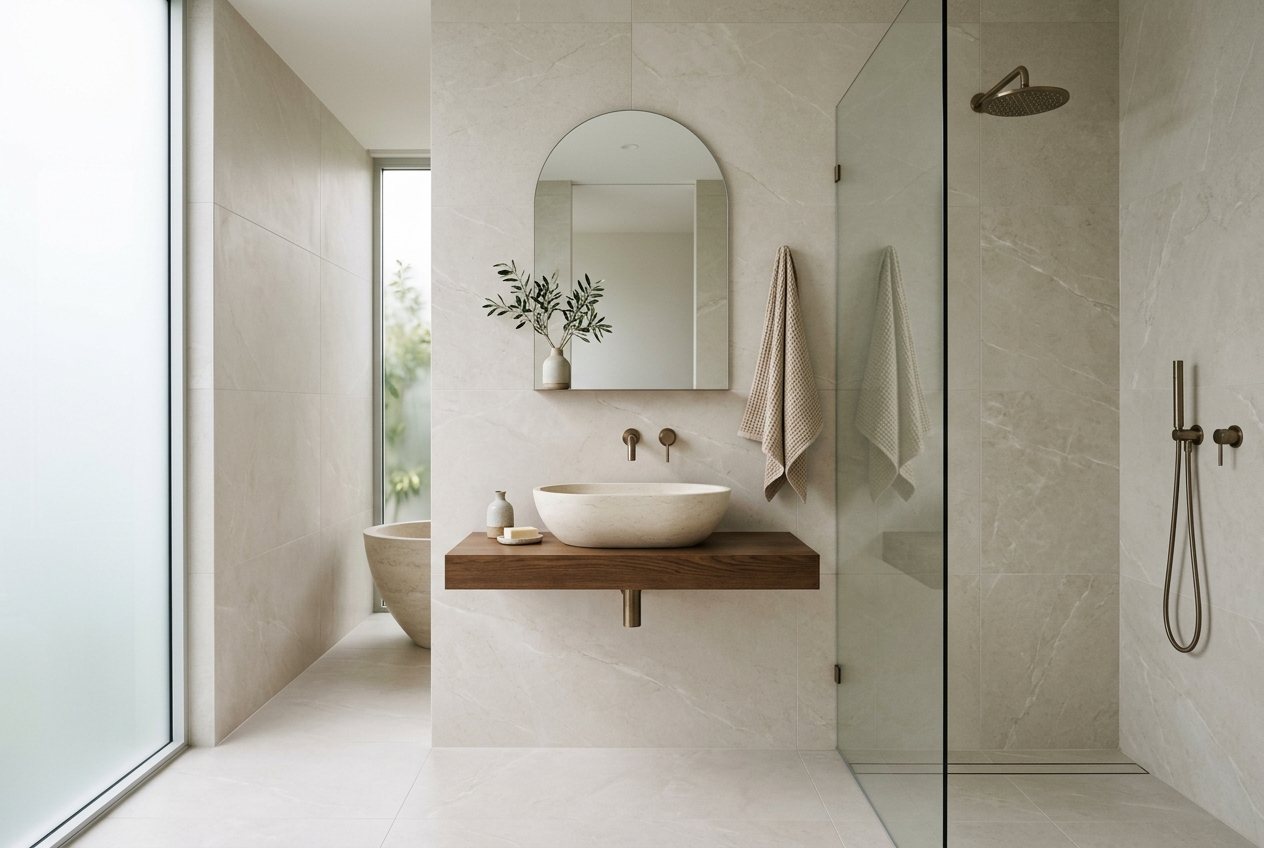
Large formats — 600x1200mm through to full 1200x2800mm slabs — have transformed bathrooms. Fewer joints means fewer lines, less visual noise and a room that reads larger and calmer, and matching wall and floor bodies carry the eye without interruption.
The trade-off is tolerance. A big tile cannot bend to follow an uneven floor, so lippage between tiles becomes visible under raking light. Budget for a levelling screed, insist on the correct notched trowel and back-buttering, and allow for the fact that big tiles are slower and more expensive to lay. This is where large-format jobs succeed or fail.
Setting-out, falls and waterproofing
Setting-out is a design decision, not a tiler's afterthought. Where the first full tile lands decides whether you end up with a slither of a cut at the most visible edge. We set out from the entry sightline and the vanity, not from a corner.
In wet areas the floor also has to fall to the waste while looking level, and the waterproofing must be designed and installed to AS 3740 with a membrane, adhesive and tile that are compatible as a system. Linear and tile-insert wastes make falls far easier to resolve in a large-format shower.
Grout: the detail everyone forgets
Grout colour changes a tiled room more than most people expect. Matched grout dissolves the grid and lets the surface read as a single field; contrasting grout draws every line and turns the tile into a pattern. Both are valid — but it should be a decision, not a default.
Joint widths: 2 to 3mm for rectified large formats, wider for pressed, handmade and zellige tiles, and wider again outside to allow for movement. Epoxy grout resists staining and is worth it in a shower floor or a kitchen splashback, at the cost of a more demanding installation.
The short version
- Porcelain for floors and wet areas; full-body porcelain where chips would show.
- Rectified tiles allow 2–3mm joints; handmade tiles need more.
- Minimum P3 (AS 4586) for domestic wet floors, P4 for shower bases, P5 for pool surrounds and steps.
- Large format needs a flat, levelled substrate — allow for it in the budget.
- Set out from the main sightline so cuts land where nobody looks.
- Choose grout colour deliberately: matched quietens the room, contrast draws the grid.
The studio holds the full tile range in Drummoyne with the tested slip ratings on file, and we will work through setting-out and grout with you against your drawings.